Just to give everyone a heads up, the Oscar-nominated short films (live action and animated) are now being shown in art house theaters around the country. These are very well done and a must-see for students of filmmaking, so check out the movie listings. A few of the films are also on YouTube, including this one, The Fantastic Flying Books of Mr. Morris Lessmore, which is touching and delightful and one of my favorites. I hope it wins!
Sunday, February 19, 2012

Saturday, February 4, 2012
The stuff dreams are made of: an acting career

An aspiring actor can spend a fortune on seminars and showcases that promise they hold the key to overnight success. Somewhere in one of the many books I've read on the profession (probably Bonnie Gillespie's Self-Management for Actors) I actually came across a casting director who claimed that over the years he had critiqued nearly 3,000 actors in these paid weekend gigs. He also admitted that in all that time he'd actually cast only 2 of them. If that's typical, those are lousy odds.
I suspect that another thing that feeds this idea of overnight success - that it's all about luck (which can't hurt) or knowing someone (which also can't hurt) - is that the industry numbers are so discouraging. A figure often cited is that most dues-paying members of the Screen Actors Guild make less than $10,000 a year (and non-union probably far less.) But what skews those numbers is that there are a lot of people who act in small stage and screen productions simply because it's fun and who really have no intention of leaving their day jobs. And then you have people who really DO expect overnight success, who put more faith into being discovered than being trained, and who then get discouraged after a few years and drop out. Nobody gets into banking "for fun," thinks they can do it without developing skills, or gets discouraged if they're not quickly made chairman of the board.
The sober reality is that like most other professions acting takes on average about 10 years of steadily working at it before you get to a place where you can begin to call yourself a successful actor. And how would I define that? Success is when you can comfortably support yourself with your acting, when the vehicles in which you perform are fully professional (and that will be obvious), and when respected directors begin to call you. After four years of working in front of the camera (behind doesn't count) I'm beginning to hit on two of those three. Six years to go.
Friday, February 3, 2012
I will be appearing on stage in Terence Rattigan's Cause Célèbre

Here's the plot: "It's 1935. The headlines scream "murder most foul!" All England is scandalized by the crime of the decade. Cause Célèbre is an emotionally complex real-life drama of love, betrayal, guilt and obsession. Did Alma Rattenbury bludgeon her ailing husband to death? Or, was it her 18-year-old lover, desperately driven by their affair into a jealous rage? Whatever the truth, she is already condemned by an outraged public for the unforgivable crime of loving a boy half her age."
Yes, it's a potboiler and a great show!
Monday, January 30, 2012
Paying the actor
Two of the major acting unions – the Screen Actors Guild (SAG) and the American Federation of Television and Radio Artists (AFTRA) are moving toward a merger, and it’s prompting much debate among those in the business over the benefits of union membership vs. non-union.
Payment for an actor’s time and talent is certainly one of those benefits, along with covering an actor’s costs – mileage, meals, drycleaning if you’re asked to provide a costume, and insurance in case you’re injured on the set. Payment can be scale or adjusted according to the size of the production, but actors typically get paid something when they’re union – and money is an obvious good thing.
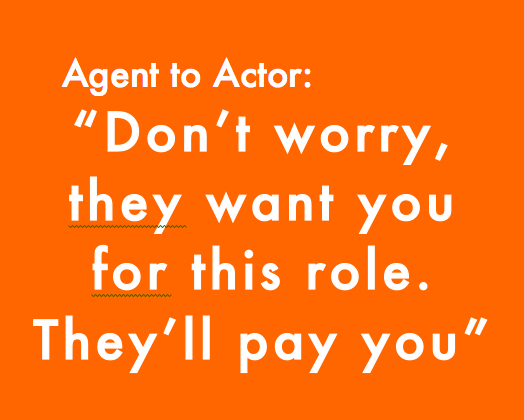
To begin with, advertising paid roles turns out a larger and often better selection of actors, which makes it more likely that exactly the right fit will be found for each role being cast. Even with a multimillion-dollar budget, bad casting can ruin an otherwise good story.
A producer/director who is paying the cast - who has invested in the cast as part of his investment in the film - is going to make sure he gets his money's worth and will demand a lot from the performance. That works to the benefit of both the actor and the film. Actors want a director who's going to demand a lot from them, not one who feels he can’t because he isn’t paying them anything.
On the other side, an actor being paid knows he has to earn it, that there's a heightened level of professionalism involved. And that sense goes up with every assist that is provided to enable him or her to turn in a good performance - from professional lighting and makeup to dancing lessons and dialect coach. For the actor who's simply donating his time, talent, gas, costume, makeup, you name it, it's a far different mindset.
I’ve worked on films being produced by students at Columbia University and other respected film schools and was paid. And I think that one reason I was paid is that the instructors at those schools understand this concept, that the more money a filmmaker has invested in a project up front, and the more he or she understands that they are working in a business with required costs, the more effort they are going to put into making it a success. And actors want every film they are in to be a success.
Every new actor starts out working for a credit and, if film, a DVD. You often get bigger roles in small, low-budget productions and if the script shows originality and the production values are reasonably high, it can be worth the tradeoff.
But as quickly as possible - which is as soon as they think they're ready - actors need to move into paid roles and union membership. It pays off in the quality of your performance, the quality of the film, and the respect you get as a professional.
Saturday, January 28, 2012
The importance for an actor of letting go

If you're an actor that approaches a role intellectually (as I do), that can be difficult to achieve. If you're in your head thinking Do I need to pause here? Walk over there? Turn my head this way? then you're not connecting with any other actors in the scene and you're certainly not connecting with the theatre audience or those who will eventually see the film.
And it shows. I have raw footage of a scene I did with the lovely and up-and-coming LA actress Walker Hays, and in the middle of one closeup I get a look in my eyes - it's just a flash - that says "What's my next line?" Although the rest of the shot appears to be fine, and the editor can cut around that momentary lapse, the performance wasn't as true as it might have been had I fully connected with Walker.
The ability to "let go," and to live in and react to the moment, is as important to good acting as it is to good sex. It means forgetting there are cameras and crew all around you and for a moment living fully in an imaginary world where only you and the other actors exist and whatever situation called for by the script is real.
Children are often surprisingly good at this, maybe because they still feel free to pretend. For adults it takes a lot of trust; in the director, in yourself, and ultimately in wherever it is fate and destiny are taking you.
Saturday, January 14, 2012
Streep is astonishing in The Iron Lady
Just a quick note: saw Meryl Streep in The Iron Lady. My God she's good - just breathtaking. The most influential world leader of the past century played by the most astonishing actor of the past century. You completely forget it's Streep. She works incredibly hard at her craft and makes it look effortless. How can they judge her for the Academy Awards? There's Streep, and then there's everyone else.
 I thought the criticisms of the film - that it dwells a bit too much on Thatcher's infirmities and not enough on her triumphs - were fair. But even so there's much about it that's terrific, even apart from Streep. The makeup is incredibly good and natural. Jim Broadbent is wonderful as Denis Thatcher. Alexandra Roach is eye-catching as the young Margaret. The film is beautifully shot.
I'm thrilled that this kind of film was written and directed by women. It's not a "woman's movie." It's not Bridesmaids. Women filmmakers are starting to turn out some great work.
I'm thrilled that this kind of film was written and directed by women. It's not a "woman's movie." It's not Bridesmaids. Women filmmakers are starting to turn out some great work.
The Un-Pilot Season
Late January to late April actually IS Pilot Season and I'm rushing about getting all my tools together. For pilots the casting agencies will be looking for name actors that will draw interest and backing. Since that isn't yet Kathryn Browning, the agencies casting pilots won't see a submission from me. Instead I'll be looking for interest from those agencies that are NOT casting pilots but casting current episodic television shows and independent films. It's a small window of opportunity. During Pilot Season many name actors are holding out for pilot auditions and a chance at a possible series so they aren't quite as available for anything else. That means slightly better odds for the rest of us in those productions that are already up and running. At least, that's the theory.

My headshot prints arrive this week along with new post cards and business cards. Cutting my demo reel down to 60 seconds and adding a couple of new clips. Putting together a mailing list of New York casting agencies that I know have cast roles for the 15 or so TV series based in New York, but who aren't on the list of those agencies casting pilots. Also listing the DC/Baltimore agencies for the features being shot there, like House of Cards with Kevin Spacey and Robin Wright, which begins shooting next month I believe. Trying to get everything out the door by next weekend as I have film and stage auditions coming up and an 8-week Meisner class that starts the 24th.
Glad to be past the holidays and seeing things moving again.
And trying not to get fired from my day job for insubordination. But that's another story (I'm so bad.)

My headshot prints arrive this week along with new post cards and business cards. Cutting my demo reel down to 60 seconds and adding a couple of new clips. Putting together a mailing list of New York casting agencies that I know have cast roles for the 15 or so TV series based in New York, but who aren't on the list of those agencies casting pilots. Also listing the DC/Baltimore agencies for the features being shot there, like House of Cards with Kevin Spacey and Robin Wright, which begins shooting next month I believe. Trying to get everything out the door by next weekend as I have film and stage auditions coming up and an 8-week Meisner class that starts the 24th.
Glad to be past the holidays and seeing things moving again.
And trying not to get fired from my day job for insubordination. But that's another story (I'm so bad.)
Subscribe to:
Posts (Atom)